2025 * 4 MONTHS * SMART TV & WEB APP
2025 * 4 MONTHS * SMART TV & WEB APP
Unify: A television experience for groups

1x
MY TEAM
MY TEAM
5 Designers
5 Designers
me!
2 Product manager / instructors
2 Product managers
MY ROLE
MY ROLE
UX & UI design
Product design
UX & UI design
Product design
LONG STORY SHORT
Unify is a Smart TV experience that helps groups choose what to watch together by balancing shared decision-making with individual preferences.
I worked as a Product Designer, leading the experience from research through high-fidelity prototyping. Rather than redesigning browsing, I focused on reducing decision fatigue and creating interactions that gave every viewer a meaningful role in the selection process.
I worked as a Product Designer, leading the experience from research through high-fidelity prototyping. Rather than redesigning browsing, I focused on reducing decision fatigue and creating interactions that gave every viewer a meaningful role in the selection process.
OUTCOME
90%
task success during collaborative content selection
27%
faster group decision-making
90%
participants agreed the experience felt fair and fun
RESEARCH
How might we make choosing something to watch feel collaborative without increasing effort or sacrificing individual preferences?
We began by studying how groups choose content together, combining literature review, competitor analysis, and group interviews to understand where existing Smart TV experiences break down and what our users' goals were.
We began by studying how groups choose content together, combining literature review, competitor analysis, and group interviews to understand where existing Smart TV experiences break down and what our users' goals were.

1x
1x
PROBLEM
Through group testing, I realized that social viewing often follows a pattern: one person controls the remote while everyone else participates indirectly, making decisions slower and leaving some users disengaged.

1x
GOALS
Users
*
*
Help groups reach decisions without frustration or decision fatigue
Help groups reach decisions without frustration or decision fatigue
*
*
Give every viewer an equal opportunity to influence what gets watched
Give every viewer an equal opportunity to influence what gets watched
Business
*
*
Increase content discovery by encouraging users to explore a wider range of titles
Increase content discovery by encouraging users to explore a wider range of titles
*
*
Support multiple viewing contexts within a single, scalable product experience
Support multiple viewing contexts within a single, scalable product experience
PROCESS
I focused on designing interactions that could adapt to different social contexts while remaining familiar to existing Smart TV users.
Exploring approaches to group discovery
I explored three concepts that prioritized these goals differently. Combining viewers' watch histories produced more relevant recommendations, but it shifted decision-making to the algorithm rather than the group. Curated collections, such as Girls' Night or Feel Good, simplified browsing but did little to resolve disagreements once multiple people were involved.
I explored three concepts that prioritized these goals differently. Combining viewers' watch histories produced more relevant recommendations, but it shifted decision-making to the algorithm rather than the group. Curated collections, such as Girls' Night or Feel Good, simplified browsing but did little to resolve disagreements once multiple people were involved.
1x
1x
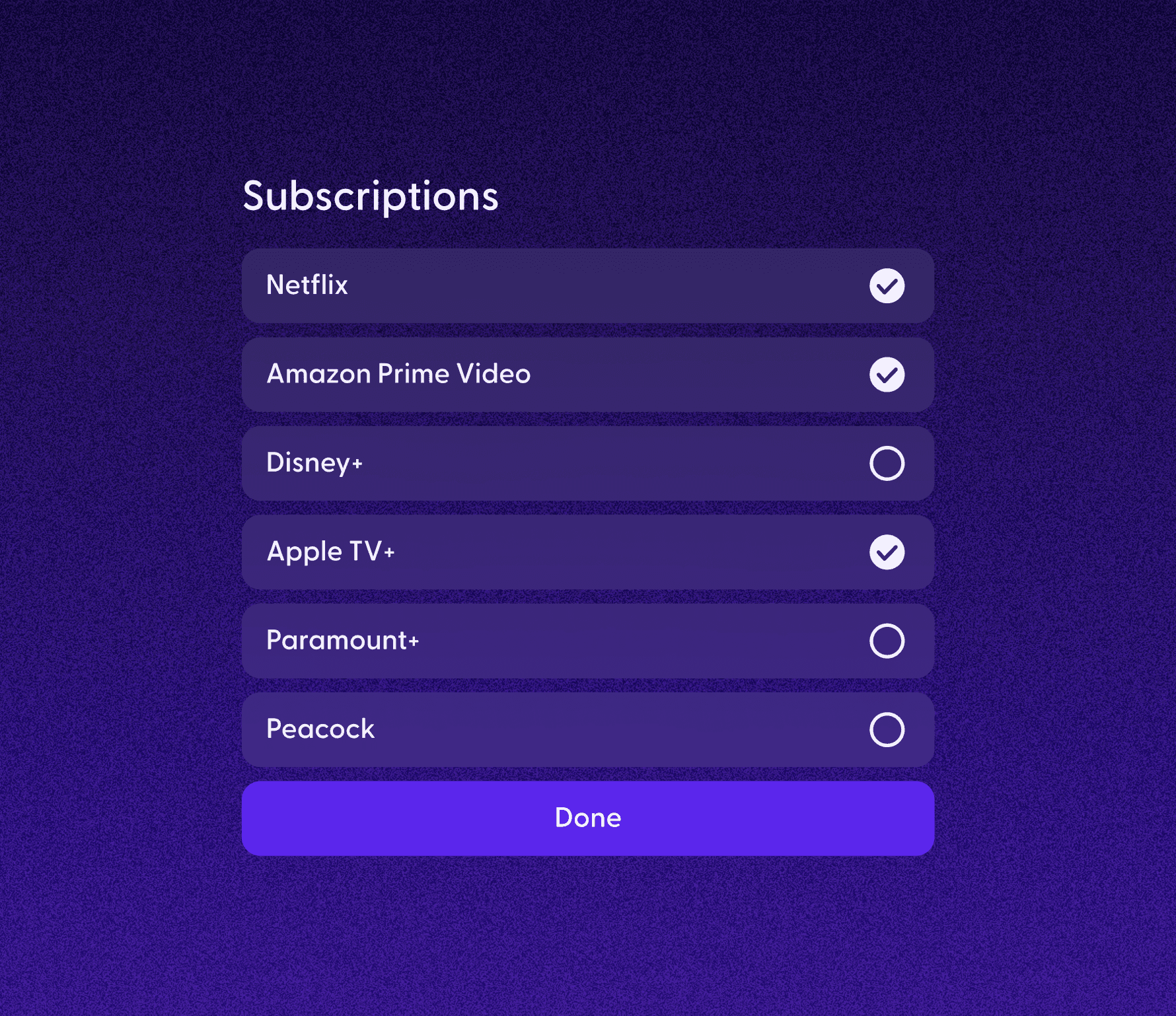
SUBSCRIPTION FILTER
Through research, users frequently expressed frustration with being given content options they didn't have access to. I suggested adding a filter to help them find accessible content.
Through research, users frequently expressed frustration with being given content options they didn't have access to. I suggested adding a filter to help them find accessible content.

1x
1x
WATCHLIST SHARING
To create further social engagement, we also put a greater emphasis on TV watchlists, allowing users to share them with other profiles and groups connected to the TV.
To create further social engagement, we also put a greater emphasis on TV watchlists, allowing users to share them with other profiles and groups connected to the TV.
Gamified interactions balanced both objectives. They preserved users' ability to influence the outcome while making the selection process itself more engaging. Rather than replacing discussion with automation, they gave everyone a structured way to participate, making this the strongest foundation for the final experience.
Gamified interactions balanced both objectives. They preserved users' ability to influence the outcome while making the selection process itself more engaging. Rather than replacing discussion with automation, they gave everyone a structured way to participate, making this the strongest foundation for the final experience.
Designing interactions for different decision-making scenarios
Rather than relying on a single interaction, we developed three complementary experiences that support different moments in the decision-making process. I was responsible for shaping how each interaction addressed a distinct user need, from building personal preferences to facilitating group consensus and resolving indecision.
Together, these interactions support different behaviours without forcing every group to follow the same decision-making process.
Rather than relying on a single interaction, we developed three complementary experiences that support different moments in the decision-making process. I was responsible for shaping how each interaction addressed a distinct user need, from building personal preferences to facilitating group consensus and resolving indecision.
Together, these interactions support different behaviours without forcing every group to follow the same decision-making process.

1x
1x
LUCKY WHEEL
Each user submits one option and the system randomly selects the final choice. Designed for moments of indecision, it removes friction and keeps the experience moving when groups are unable to agree.
Each user submits one option and the system randomly selects the final choice. Designed for moments of indecision, it removes friction and keeps the experience moving when groups are unable to agree.

1x
PICK OR PASS
A swipe-based interaction where users quickly like or skip content to build personalized watchlists over time. This helps reduce decision fatigue by preparing options in advance and gathering better data for recommendations.
A swipe-based interaction where users quickly like or skip content to build personalized watchlists over time. This helps reduce decision fatigue by preparing options in advance and gathering better data for recommendations.

1x
VOTE & CHILL
A voting experience where users join and vote while trailers play. It helps groups reach decisions more efficiently through a democratic and compromise-driven approach.
A voting experience where users join and vote while trailers play. It helps groups reach decisions more efficiently through a democratic and compromise-driven approach.
Refining the content browsing process
While the project focused on collaborative decision-making, I also revisited the core browsing experience. Traditional Smart TV interfaces rely on static cover art, requiring users to repeatedly open and close content pages to understand whether a title is worth watching.
While the project focused on collaborative decision-making, I also revisited the core browsing experience. Traditional Smart TV interfaces rely on static cover art, requiring users to repeatedly open and close content pages to understand whether a title is worth watching.
WATCHLIST REDESIGN
My redesign of the common watchlist browsing process focused on minimizing clicking into and back out of movie titles by putting the movie info directly on the screen during scrolling.
My redesign of the common watchlist browsing process focused on minimizing clicking into and back out of movie titles by putting the movie info directly on the screen during scrolling.
I redesigned the browsing lists to support faster evaluation by surfacing key information directly within the catalogue. Hovering over a title reveals its summary while automatically playing the trailer, allowing users to compare options with fewer interactions and reducing the friction of repeatedly entering and exiting content pages.
I redesigned the browsing lists to support faster evaluation by surfacing key information directly within the catalogue. Hovering over a title reveals its summary while automatically playing the trailer, allowing users to compare options with fewer interactions and reducing the friction of repeatedly entering and exiting content pages.
TESTING & ITERATION
Three rounds of moderated usability testing were conducted with five groups to evaluate how effectively the experience supported collaborative content selection
Usability Testing
Three (3) rounds of testing with five (5) groups of two or more participants.
Three (3) rounds of testing with five (5) groups of two or more participants.
*
*
Complete a list of tasks while thinking aloud
Complete a list of tasks while thinking aloud
*
*
Describe their satisfaction with the product's ability to support collaborative decision-making
Describe their satisfaction with the product's ability to support collaborative decision-making
Improving discoverability
While participants quickly learned the mechanics of each game, testing revealed that the purpose of each interaction was not immediately clear. Users often selected a game without understanding how it supported different decision-making scenarios.
While participants quickly learned the mechanics of each game, testing revealed that the purpose of each interaction was not immediately clear. Users often selected a game without understanding how it supported different decision-making scenarios.

1x
1x
Before
LACK OF CONTEXT
Games used gradients to differentiate from one another, but they blended together and didn't give the user any idea of their purpose.
Games used gradients to differentiate from one another, but they blended together and didn't give the user any idea of their purpose.
1x
After
GAME DIFFERENTIATION
I designed clear branding and imagery that hints at the games purpose from the first glance, bringing clarity to the experience.
I designed clear branding and imagery that hints at the games purpose from the first glance, bringing clarity to the experience.
I redesigned the branding for each of the games and introduced concise overview animations and contextual cues that communicate the intent of each game before users begin. By making the differences between the experiences explicit and visual, users were better able to choose the interaction that matched their viewing context instead of relying on trial and error.
I redesigned the branding for each of the games and introduced concise overview animations and contextual cues that communicate the intent of each game before users begin. By making the differences between the experiences explicit and visual, users were better able to choose the interaction that matched their viewing context instead of relying on trial and error.

1x
Before
TEXT HEAVY INSTRUCTIONS
Each of the games featured an instructional page that followed the same exact structure. It relied heavily on text instruction and felt disorganized.
Each of the games featured an instructional page that followed the same exact structure. It relied heavily on text instruction and felt disorganized.
After
OVERVIEW ANIMATIONS
I reorganized the overview screen to contain an instructional animation, entrance code, and group member status bar. This helped break down the information and relies less heavily on text to convey the same information, allowing the user to understand how the game works with minimal effort.
I reorganized the overview screen to contain an instructional animation, entrance code, and group member status bar. This helped break down the information and relies less heavily on text to convey the same information, allowing the user to understand how the game works with minimal effort.
Supporting both individual and group viewing
Early prototypes treated the games as a group-only activity. Testing revealed that participants also saw value in using it independently to discover content and build preferences before watching with others.
Early prototypes treated the games as a group-only activity. Testing revealed that participants also saw value in using it independently to discover content and build preferences before watching with others.
PICK OR PASS FOR INDIVIDUALS
Implementing one of the games into solo play allows users to become familiar with the value that the games bring. Played using the physical remote or web app for flexibility.
Implementing one of the games into solo play allows users to become familiar with the value that the games bring. Played using the physical remote or web app for flexibility.
Supporting every interaction in both contexts might have weakened the product's emphasis on collaborative viewing. Instead, I proposed limiting individual use to Pick or Pass, allowing users to build watchlists and improve future recommendations on their own, while reserving Vote & Chill and Lucky Wheel for group sessions where shared decision-making provides the greatest value.
Supporting every interaction in both contexts might have weakened the product's emphasis on collaborative viewing. Instead, I proposed limiting individual use to Pick or Pass, allowing users to build watchlists and improve future recommendations on their own, while reserving Vote & Chill and Lucky Wheel for group sessions where shared decision-making provides the greatest value.
OUTCOME
The final round of group testing evaluated the experience against the project's primary goals.
The final round of group testing evaluated the experience against the project's primary goals.
90%
90%
task success during collaborative content selection
task success during collaborative content selection
27%
faster group decision-making
90%
participants agreed the experience felt fair & fun
27%
faster group decision-making
90%
participants agreed the experience felt fair and fun
1
1
This project taught me not to assume interactions are intuitive without validation. I also learned that interface design directly shapes group behavior, not just individual actions. Balancing individual and group needs pushed me to think critically about trade-offs and long-term use.
This project taught me not to assume interactions are intuitive without validation. I also learned that interface design directly shapes group behavior, not just individual actions. Balancing individual and group needs pushed me to think critically about trade-offs and long-term use.
2
2
If I could go back, I would think more critically about the balance between meeting user and business needs. Especially when it comes to incorporating promotional materials for the business.
If I could go back, I would think more critically about the balance between meeting user and business needs. Especially when it comes to incorporating promotional materials for the business.
createdbylib@gmail.com
© 2026 Libby Wilken
createdbylib@gmail.com
© 2026 Libby Wilken
createdbylib@gmail.com
© 2026 Libby Wilken
4DB34D